
A green number appeared. Everyone stopped asking questions.
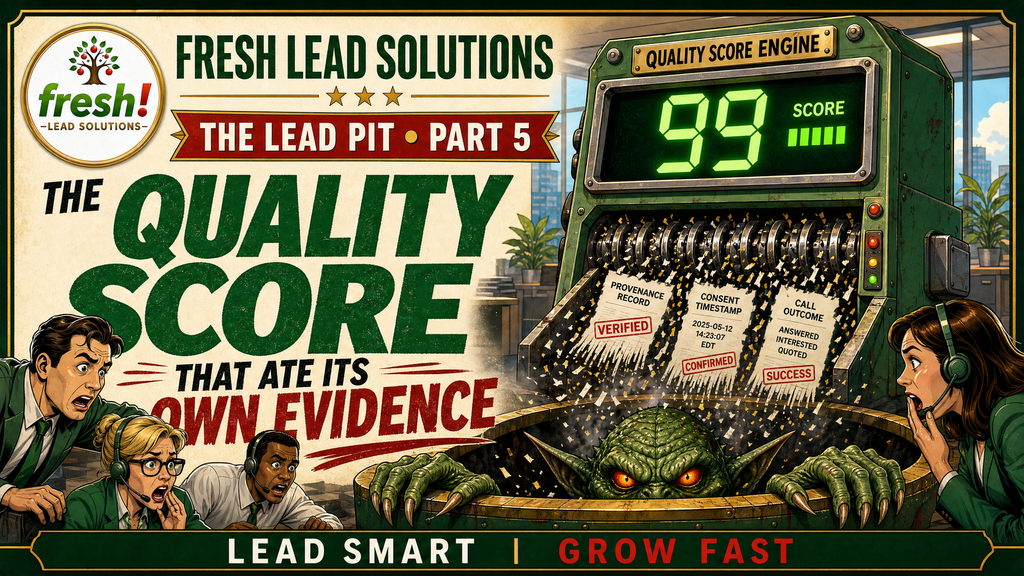
A green number appeared. Everyone stopped asking questions.
Our model gave the lead an 87. Nobody could explain the 87, but it was green and therefore emotionally persuasive.
I asked the data scientist who built the model to walk me through it in a meeting once.
“Why 87 and not, say, 72?”
“It’s a weighted composite of engagement signals, contact recency, and a few demographic factors.”
“Which factors moved it up the most?”
He paused, pulled up a screen, scrolled for a while. “I’d have to dig into the logs to tell you that specifically.”
“So right now, nobody in this room can tell me why this lead outranked the one that scored a 61?”
Nobody could. We had automated confidence before we had earned comprehension.
A score is a compressed argument
Every score hides definitions, weights, missing data, thresholds, and tradeoffs. I brought this up with a sales manager who loved the model precisely because it was simple.
“I don’t need to understand it,” he told me. “I just tell my agents to work the high scores first.”
“What happens when the high scores stop converting better than the low ones?”
“Then I guess the model’s wrong.”
“How would you know it’s wrong if you never understood what it was measuring in the first place?”
He didn’t have an answer. If I cannot explain what evidence moved a record up or down, I do not have a decision system. I have numerology with conditional formatting.
Automation inherits the mess
Salesforce’s 2026 State of Marketing reported that 75% of surveyed marketers had adopted AI, while 84% still ran generic campaigns and 98% faced personalization barriers. I mentioned this stat to a vendor who was pitching an AI-scoring add-on.
“This’ll fix your lead quality problems,” he said. “It’s machine learning.”
“Machine learning trained on what data?”
“Your historical lead data.”
“The same historical lead data that already has duplicates, missing consent fields, and no household matching in it?”
He didn’t love that question. That is not a verdict on lead scoring; it is a warning that sophisticated tools do not automatically repair fragmented inputs. [1]
The FLS aspiration
I want scores tied to observable outcomes, monitored by source and segment, reviewed for drift, and overridden with a reason. I said as much to a colleague who thought that sounded like a lot of extra process.
“Why not just trust the number and move on?”
“Because the number replaced a conversation we used to have. We used to ask why a lead looked promising. Now we just look at the color.”
“Isn’t that more efficient?”
“It’s faster. It’s not the same as being right.” The score should invite better questions — not end the meeting.
Continue the story
Next: The Disposition Graveyard—where agent feedback goes to be buried.
Sources and scope
[1] Salesforce, State of Marketing 2026
Published facts are cited and qualified. First-person observations, metaphors, and satire are commentary—not universal claims. This article is education, not legal, tax, compliance, financial, or insurance advice.
See what your own pipeline looks like once it’s actually scored. Start the audit at freshleadsolutions.com
Continue The Lead Pit series at blog.freshleadsolutions.com
Leave a Reply